This notice replaces LMN 2023-01.
Southern Ports Esperance has become aware of several recent incidents related to the failure of pilot ladders or their associated equipment caused by poor condition or improper rigging.
Investigations show that these incidents were caused by a lack of supervision, awareness of safety requirements and inadequate maintenance.
Incorrectly rigged pilot ladders or pilot ladders that are in poor condition can have serious consequences, including the possibility of severe injuries or the loss of life for personnel using pilot ladders.
All vessels calling the Port of Esperance must comply with the following requirements:
1) All pilot ladders, manropes and associated equipment are to be used only for marine transfers (pilots and other personnel) and must not be used for any other operations onboard the vessel such as for draught readings or any maintenance work.
2) Pilot ladders must not be used beyond 30 months from the date of manufacture.
3) Manropes must not be used beyond 12 months from the date of manufacture.
4) Associated ropes used to secure the pilot ladder to a strong point on deck or to a pilot ladder winch must be certified to a minimum strength of 48Kn. These ropes should be renewed no later than 12 months from the date of first use with records to be maintained in the vessel’s Planned Maintenance System.
5) The rope used to extend the length of the pilot ladder from the winch must have a minimum BS of 48KN and must be certified by the pilot ladder manufacturer and must not be used beyond 30months from date of manufacturer. The shackle and thimble used in the extension rope must also have a minimum rating of 48KN.
6) To use a pilot ladder beyond 30 months from the date of manufacture the following requirements must be complied with:
6.1) The ladder must pass a ladder and step attachment strength test as per ISO -799-1:2019
6.2) Any ladder repairs and testing must be carried out by the manufacturer or by a manufacturer-approved repair facility, or a facility approved by the Flag State or Classification Society with proof in the form of a test certificate and/or an updated certificate
Additionally, Vessel operators, Masters and Crew should ensure that:
- Pilot ladders must be certified by the manufacturer / Classification Society as complying with requirements as mentioned under either IMO Resolution A.1045(27) or International Standard ISO 799-1:2019. Proof of certification MUST be kept on board and produced when requested by the duty pilot.
- Vessels are required to maintain certificates of Manropes and associated ropes, shackles, thimbles used in the rigging of pilot ladder.
- Vessel operators are required to ensure that the rigging of pilot ladders must be carried out by properly trained and competent crew, and the rigging must be inspected by a suitably trained officer prior to the pilot embarking or disembarking the vessel.
- Adequate training and guidance should be provided by the vessel operator for the crew to competently carry out proper inspections and remove pilot ladders from service when defects are identified.
- Maintenance and inspection routines for the pilot ladders and all associated equipment like stanchions, shackles, manropes, deck fittings, securing ropes etc., should be included in the vessels Planned Maintenance System.
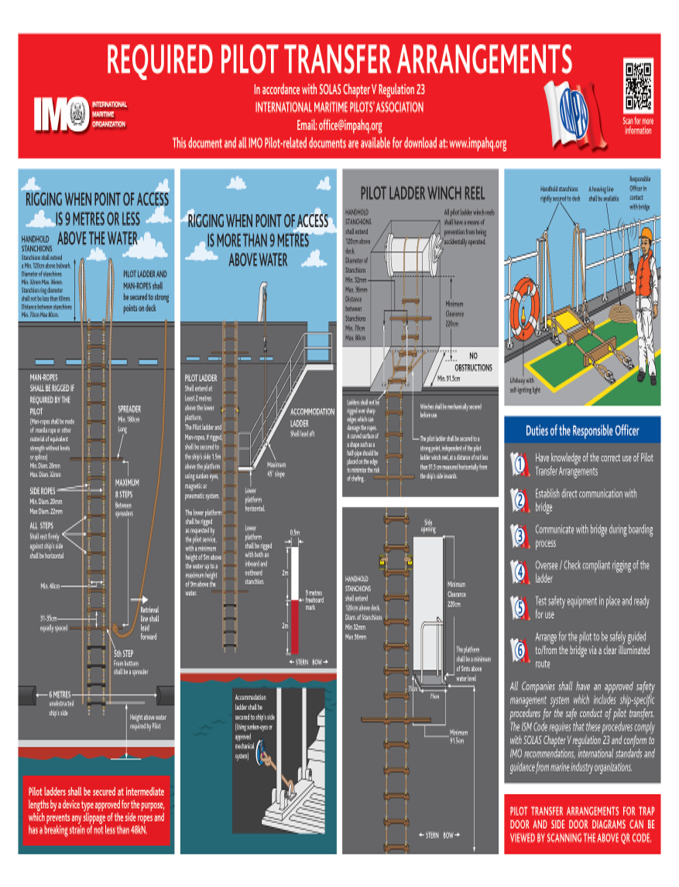
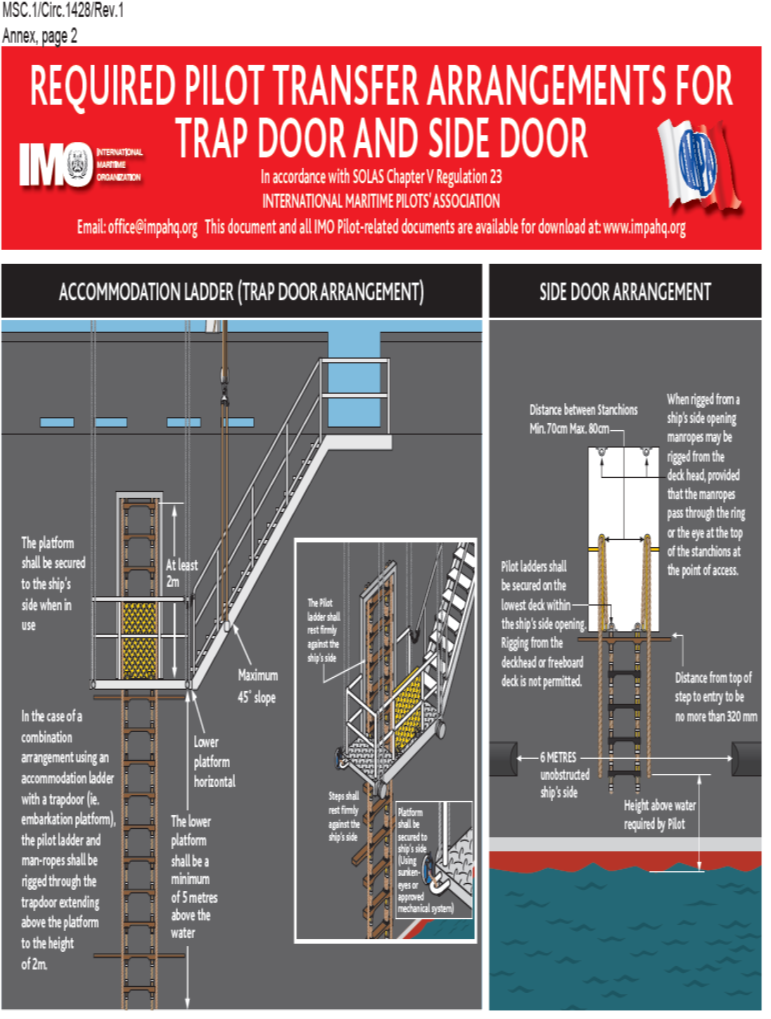
When the Freeboard exceeds 9m a combination ladder must be rigged:
- The pilot ladder must extend at least 2 metres above the lower platform of the gangway.
- The ladder must be firmly attached to the ship’s side 1.5 meters above the accommodation platform.
- Manropes are to be rigged as directed by the pilot.
- When manropes are required with a combination ladder, they shall be attached to the ships side 1.5 meters above the accommodation ladder platform.
- The accommodation ladder must be secured to the ship’s side.
- The accommodation ladder may only have a maximum slope of 45 degrees and should lead aft.
- The lower platform must be horizontal and must have a non-slip surface.
- The lower platform shall be a minimum of 5 meters above the sea.
- The responsible officer must be located on the lower platform with a hand-held VHF on CH12.
Magnetic Attachment Plates:
- Where a combination ladder is required and there are no lugs for securing the ladder against the ship’s side, securing magnetic plates with lugs must be used.
- The port of Esperance has magnetic lugs which may be used by the vessel to correctly rig the ladder.
- This equipment is provided free of charge and must be requested through the vessel’s agent well in advance so that delays may be avoided.
Any vessel which has a non-compliant, poorly rigged or damaged pilot ladder will not be permitted to berth at Port of Bunbury until a compliant pilot ladder, meeting the above requirements, is available and installed.
Inbound vessels should have the pilot ladders rigged as follows, (unless expressly specified by the Pilot);
Pilot ladder is to be rigged on the port side of the vessel one (1) metre above the waterline.
For additional guidance for rigging and maintenance of pilot ladders, manropes, and associated equipment, the following documents should be referred to:
- ISO 799-1 Pilot Ladders - Design and Specification
- ISO 799-2 Pilot Ladders - Maintenance, Use, Survey and Inspection
- ISO 799-3 Pilot Ladders – Attachments and associated equipment
- SOLAS Chapter V Reg 23
- IMO Circulars MSC.1/Circ. 1428 and MSC.1/Circ. 1495
- IMO Resolution A.1045(27)
- IMO Resolution A.1108(29) which contains an amendment to 5.1 and 5.2 of A.1045(27)
- IMO Resolution MSC.576(110)
- IMO Resolution MSC.572(110)
- AMSA Marine Notice – 04/2023 – Pilot Transfer Arrangements
- ARCSOPT-Technical-Guideline-03-23-Marine-Pilot-Transfer-Arrangements.pdf (arcsopt.org)
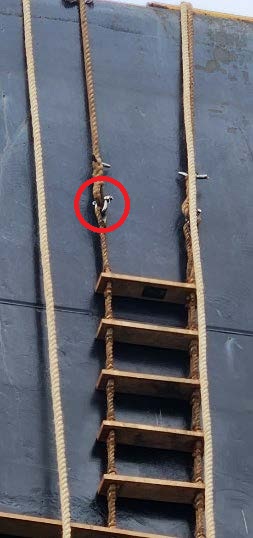
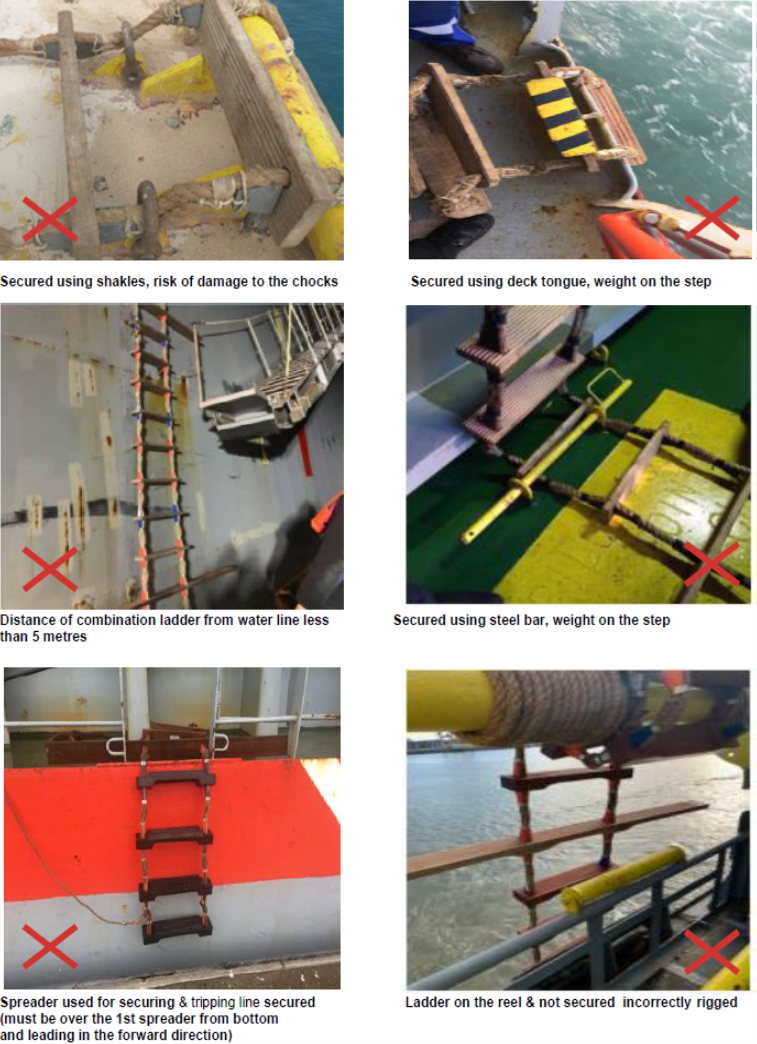
Examples of incorrect securing methods of Pilot Ladders in practice
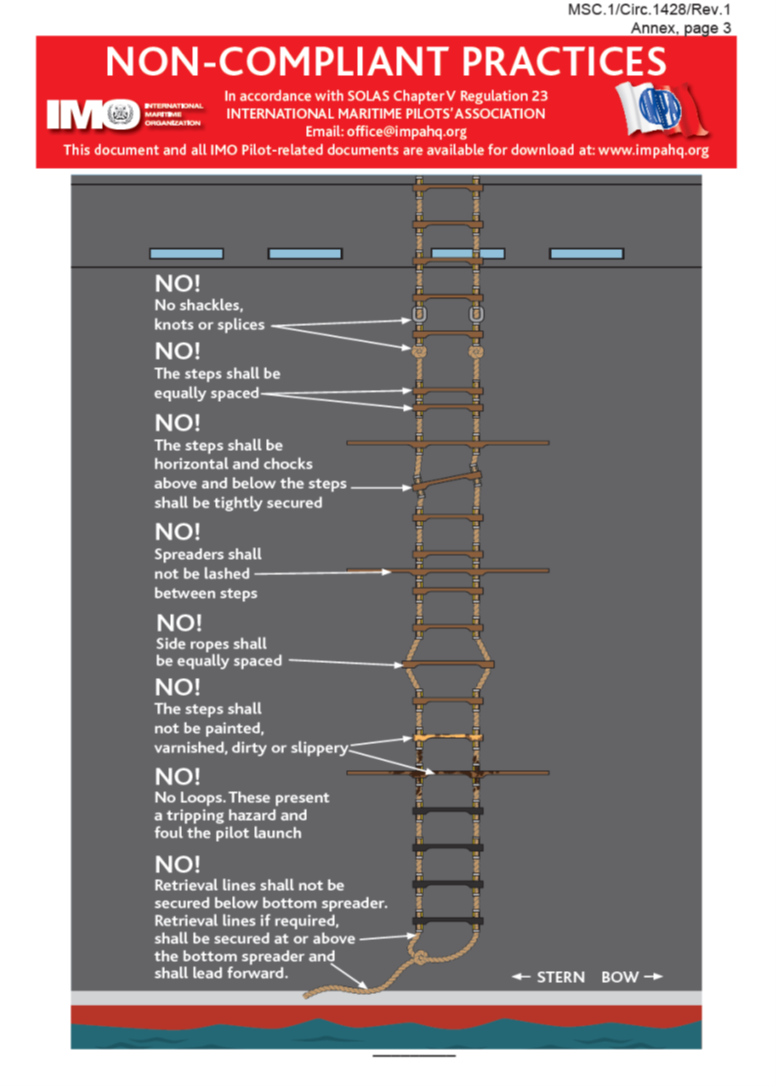
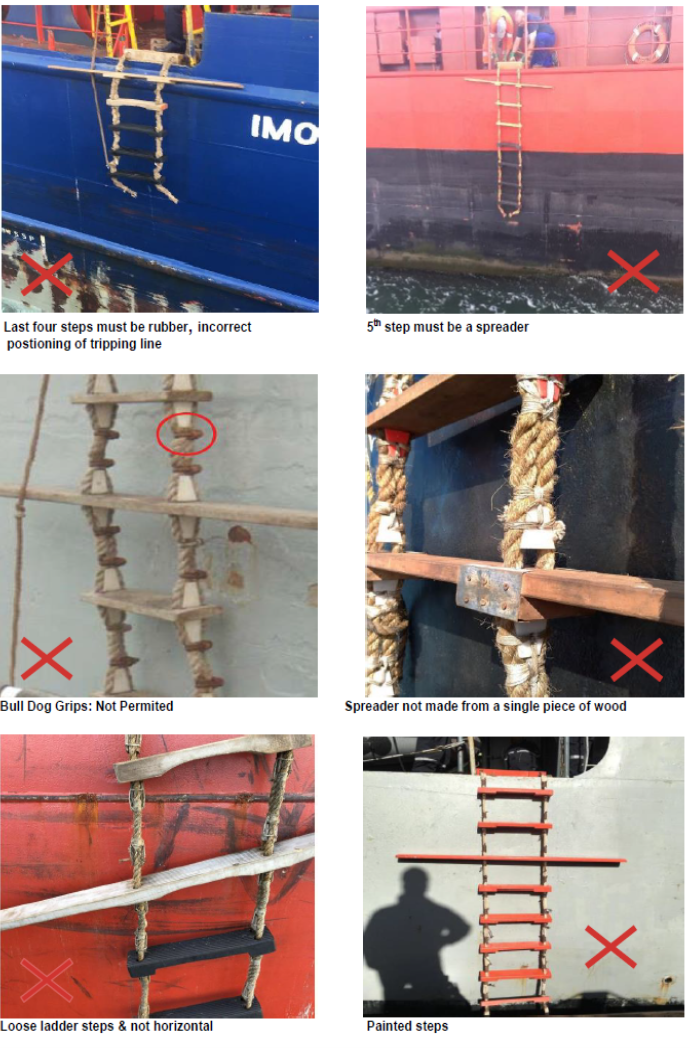
Examples of non-compliant construction
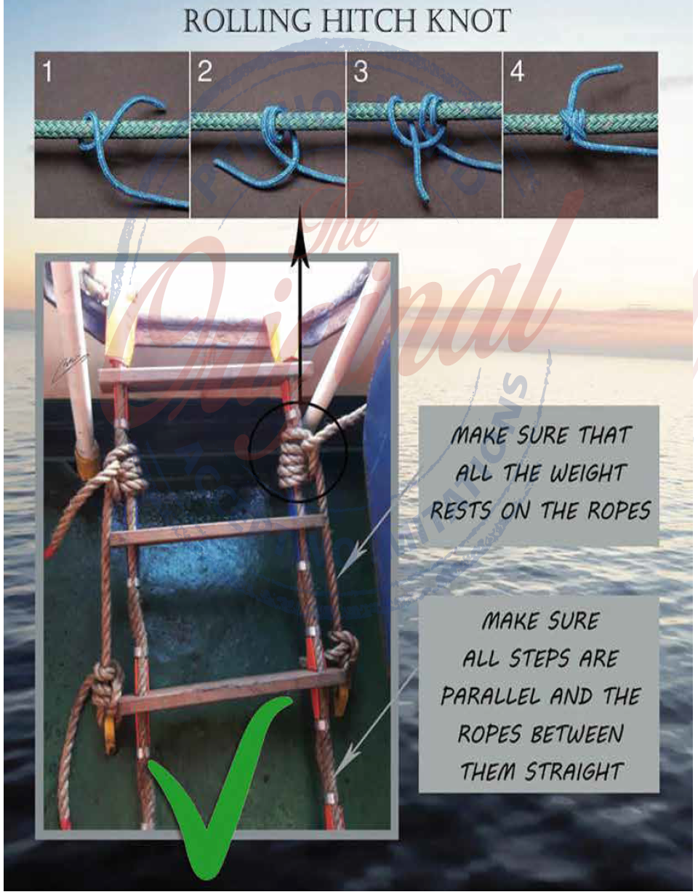
How to secure a Pilot Ladder correctly
Refer to the latest diagram published by IMO which is in accordance with SOLAS V/23 and amendments as per IMO Resolution MSC.576(110) and MSC.572(110)