Pre-arrival information
Ships’ Masters must notify the Harbour Master immediately of any emergency situation onboard their vessel.
Refer to charts AUS 118 for the location of the Port of Albany limits.
All vessels MUST have chart AUS 118 before entering port waters. If they do not they must advise their agent who will arrange for the chart to be supplied by launch on arrival at port limits.
VHF listening watch on VHF Ch16 and Ch12 maintained on weekdays between 0830hrs to 1700hrs. For shipping movements the Pilot will contact vessel on VHF one hour before Pilot on board time. Call sign “Albany Port”.
Ships Masters must note the following arrangements in relation to berthing at the Port of Albany:
- All vessel movements are the responsibility of the Port’s Pilots while the Master’s ultimate responsibility remains.
- All vessels should move through the Port as efficiently and quickly as is safely possible
- All decisions will be made with a ‘whole of Port’ focus, which includes community considerations
- Vessels arriving before their required berthing time may be berthed on arrival at the Port’s convenience. Port dues will commence on hour after the scheduled Pilot on board time
There are 7 anchorage positions A, B, E, F, G. X, Y. While anchorage positions D and Z are the only allocated anchorage for Holds Inspection. Anchorage position C and W are temporarily unavailable and should not be used. Southern Ports will advise the agent which anchorage the ship must proceed to.
Transit from Albany Port limits to the anchorage area is permitted without a pilot. Masters must confirm their allocated anchorage with the port prior to entering King George Sound by sending an email to [email protected]
Woodchip vessels to anchor at anchorage G – King Point light bearing 276 deg (T) x 2.9 Nautical Miles unless otherwise advised.
For safe navigation, vessels should be trimmed by their stern, their propeller fully immersed and the forward draft must be 25% of moulded depth and the aft draft must be 37% of moulded draft. Vessels that cannot meet these criteria may be delayed until compliant at Harbour Master / Duty Pilots discretion.
Standard vessel movements within the Port of Albany require a minimum of 2 tugs on each movement.
The port uses the services of Svitzer Australia Pty Limited for its operations, and they presently provide two ASD tugs Karoline and Maryon which have:
65 MT Bollard pull over the stern - 3600HP - 3676kW
Pilotage is compulsory for all vessels over 500 GRT. The pilot boarding ground (see chart AUS 118), position 35°04.0´ S, 118° 00.0´ East.
For ships at anchor the pilot will board at the anchorage.
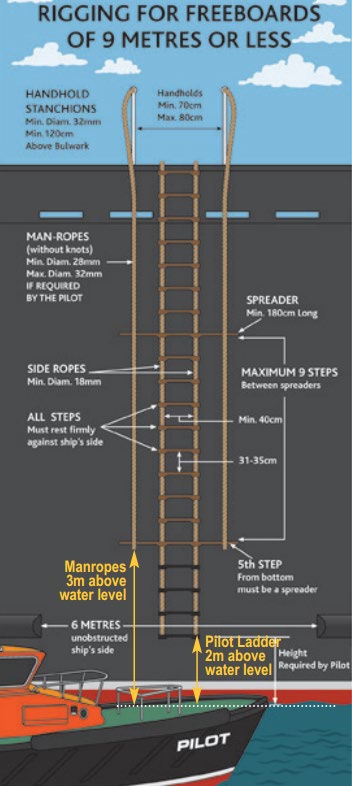
Pilot boarding arrangements must comply with IMO requirements and IMPA recommendations. See diagram.
In the case of a combined ladder, the Ship’s Officer in contact with the bridge should be positioned at the lower gangway platform.
The ladder is to rest firmly against the ship’s side and should be lashed to the pilot ladder lugs.
If the vessel does not have securing lugs, securing magnets are available from the port and should be requested prior to the pilot boarding.
The Master is to provide a lee for the safe boarding of the pilot.
All vessels are required to provide the Pilot with a Pilot Card containing appropriate information. The Pilot will provide the Master with a Port Passage Plan.
The Agent is to ensure that the Master receives the Local Marine Notices electronically in good time prior to arriving at port limits.
Bridge Resource Management (BRM) principles for pilotage apply.
Should the Master or Officer of the Watch have any concerns about any part of the manoeuvre, they are to bring this to the attention of the Pilot who will respond to their concerns.
Port of Albany Pilot’s welcome feedback, comments, and suggestions – contact us.
- Ships’ Masters are to adequately secure their vessels at all times when alongside a berth;
- Mooring lines are to be tended at appropriate intervals throughout each 24-hour period to ensure vessels are securely positioned alongside the berth without ranging. All lines are to be in a good condition and kept firm with even tension to minimise the risks of lines parting. Winch brakes must be in good condition and applied firmly when lines are not being adjusted;
- Berth no.6 is exposed to the interaction from a passing ship. Ensure that the ship’s gangway being used is always clear from structures for possible ship movement and all lines need to be tight and tended at all times.
It is the Masters’s responsibility to ensure they maintain the minimum under-keel clearance of 0.60metres (Berths 3 & 6) and 0.40 metres (Berths 1 & 2) while alongside berths at all times. Minimum DUKC of 1.20m or 10% of the deepest draft in the swing basin and in the channel is required at all times. Whichever is appropriate.
All MARPOL Regulations, as well as our Local Marine Notices are to be strictly complied with.
Port of Albany applies Regulation 17 of the Western Australian Port Authorities Regulations 2001 (Dec 2022) that states: “Unless authorised by a member of staff of the Port Authority, the Master of a vessel must not cause or permit any waste water or waste substances of any kind to be discharged from the vessel onto any part of a wharf or into the waters of a Port.”
Port of Albany applies this regulation to the following forms of waste water derived from:
- Dry bulk cargo residues, hold cleaning and deck washings;
- Sewage;
- Oil, bilge water and oily water;
- Sediment;
- Grey water;
- Other waste water; and
- Open Loop Scrubbers
Ship’s Master must confirm that EGCS is compliant with AMSA/IMO regulations and has been tested and found to be functioning in accordance with those regulations. Additional measures required: vessel to demonstrate (current laboratory testing certificates - within three months) that the water quality of the emissions of their on-board system are able to comply with the relevant state water quality requirements. If a vessel is unable to comply, and must discharge waste water, the Ship’s Master must contract a Controlled Waste Carrier in Albany that can collect and dispose of this waste. Contact must be made in advance to enable the correct fittings to be installed to allow collection of this waste. In Port of Albany, operation of open-loop scrubber is prohibited. All Ships’ Masters must declare compliance with these conditions.
Ships’ Masters are to observe the following in relation to a vessel’s cleanliness when in Port of Albany waters:
- Masters are to ensure that cargo residues do not enter Port of Albany waters from their vessels by any means;
- Under no circumstances should cargo residues enter Port waters during periods of heavy rain, high wind or de-ballasting of cargo holds; and
- Ballast and other discharges must not be allowed to fall on Port wharfs, plant or equipment. Non-compliance with this directive may result in a Ship’s Master being prosecuted under Australian Marine Orders and Environmental Legislation.
- Make sure to put in place all scupper plugs around the vessel for pollution control
Discharge of garbage from vessels and cleaning of sea containers is regulated by the Biosecurity Act 2015. To comply with the Biosecurity Act and regulations, shipping agents or the ship’s master must notify the Shipping Officer during the berth application process of their requirements for disposal of biosecurity garbage waste from the vessel (or from imported sea containers). All biosecurity waste must be double bagged and tied up and deposited in specially marked “BIOSECURITY” bins on the berth or bins near the container inspection stand.
Weather – prevailing winds, Southwesterly in winter and Easterlies in summer.
Tides – range one metre but can be influenced by weather conditions.
To view current weather conditions visit Albany weather.


