Seafarer shore leave
Please be advised that the following procedures will apply regarding the issue and use of Southern Ports Security Access Cards, high visibility vests and bus transfers for your ship’s crew. The following procedures are to be strictly followed:
- Cards are to be issued to each crew member with the card number corresponding to their number on the crew list as supplied to the Port Security Office. The crew cards are non- transferable.
- The number of crew shore access cards will not exceed numbers on the vessel’s crew list.
- Crew MUST carry Seamans Book while leaving the vessel to go on shore leave.
- Crew shore access cards and Seaman’s Book are for individual identification of crew by bus driver.
- Crew members are not permitted on or near any other berth.
- Crew shore access cards will be fitted with clips and must be visibly displayed at all times whilst crew are on port land.
- Crew are to wear provided high visibility vests and walk directly to the pickup point on designated walkways. Hard Hats are to be worn while walking to pick up point.
- Crew are to remain at the bus shelter until the bus arrives at the pickup point.
- A bag with 20 high visibility vests is supplied to the Agent for the vessel. Prior to departure return the bag with vests to the Agent. The vessel will be charged a fee of AUD$20.00 for each vest not returned.
- A fee of AUD$74.80 will be charged per escort for any crew members found on foot in unauthorized areas of the Port. This fee will also apply for a crew member who misses the last scheduled bus run and requires escort back to the vessel by Port staff.
- The master is to return all crew shore access cards to the vessel’s agent prior to departure. The vessel will be charged a fee of AUD$50.00 for each card not returned
Crew are not to enter any other part of the Port with transfers to and from the berth by bus only. The Seafarers Mission (Mission to Seafarers Esperance) is contactable for transport on +61 8 9071 6813.
| Time | Allocation |
|---|---|
| 10:30 | First pick up |
| 15:00 | Drop off and pick up |
| 18:30 | Last return bus |
In order to keep the seafarers’ transfer bus personnel and ship’s crew safe whilst transiting to and from berths and through operational areas of the Esperance Port, the following pick up and set down arrangements will apply.
Transfer Bus Access to Berths (Embarking and Disembarking)
Strictly No Access to berths during mooring activities.
On arrival at Port Security gate, and prior to proceeding to the berth, the transfer bus driver is to contact Southern Ports Shift Superintendent by VHF radio channel 1 or mobile 0447 838 290 for confirmation to access the berth.
Seafarer’s MUST carry their Seaman’s Book at all times for identification purposes while off the vessel.
Vests and Hard Hats must be worn when travelling from gangway to bus shelter.
Pick-up Arrangements per Berth and Vessel Type (Disembarking)
Berth 1 and 2 Containers, Grain, General Cargo Ships and Fuel Tankers:
Crew are to wait at the gangway onboard until bus arrives.
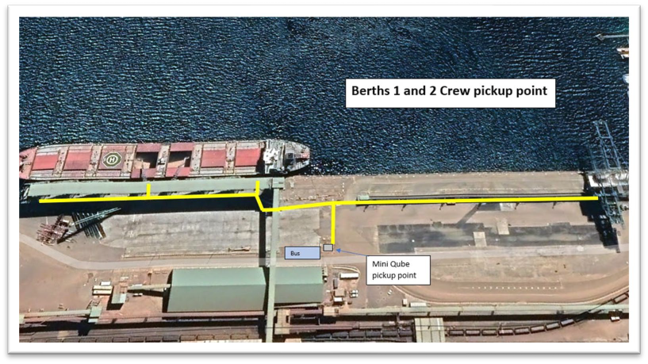
Once bus arrives, crew are to leave the vessel en-masse and follow designated walkways (illustrated on the attached maps) from their vessel directly to the bus.
Crew are to watch out for and “Give Way” to any vehicles that may cross their path.
Berth 3:
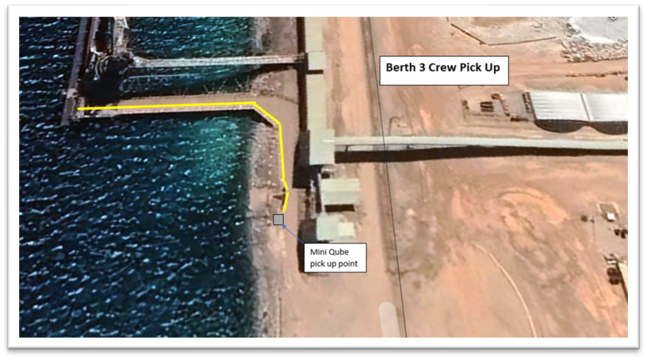
Crew are to remain at the bus shelter until the bus arrives.
Once the transfer bus arrives, crew may make their way to the bus.
Set-down Arrangements (Embarking)
Crew will be set down at the relevant bus drop off point and are to make their way via designated walkways directly to the vessel gangway.
Agent Notice
Agents who transport crew off site must contact the Seafarers Centre on departure if the Last Return Bus is required; as the service may not be available.
The Mission to Seafarers Esperance is available for respite.
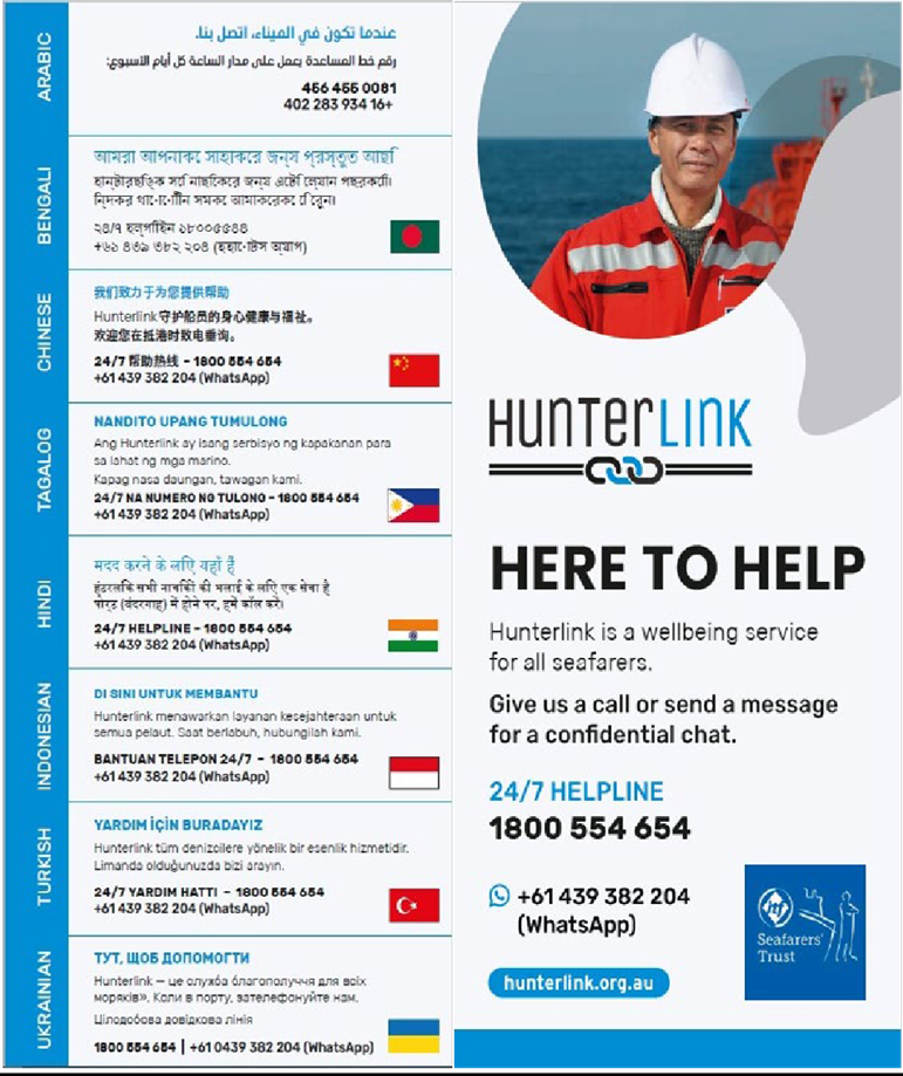
Hunterlink service can also be contacted for wellbeing support.
For more information on seafarer support initiatives at Southern Ports visit Seafarer welfare.
Cargo handling information
Co-operative Bulk Handling operates a grain loader over Berth No.1 with a nominal loading rate of 2500 tonnes per hour (1250 tonnes per hour per loading arm with a maximum of two loading arms being used simultaneously). The grain loading facility has the following specifications:
- Loading rate max 1100 tonnes per hour, per spout;
- Seven fixed loading arms using two conveyor systems;
- Panamax Vessels up to 230m LOA are allowed to call at berth 1, subject to the following conditions:
- If the distance from the bow to the forward edge of hatch 7 exceeds 174 metres (maximum reach of the last grain spout) this may cause hatch number 7 to be left slack. The case of hatch 7 left slack can only be acceptable if it is accounted for in stowage plans and stability conditions. Those plans must be fully compliant with the International Code for the Safe Carriage of Grain in Bulk. Said compliance needs to be verified before commencing cargo operations, irrespectively of the inability to fully load hatch 7 due to the limitations in reach of loading conveyors and spouts.
- Loading plans and stability conditions compliance falls entirely and exclusively under owner/shipper/charter/ship responsibility and null Southern Ports.
- Acceptance of vessels remain subject to AMSA approved stowage plans, to be supplied to SPA prior to the berthing.
- The vessel shall never exceed 18 metres overhang from the western end of berth 1 and shall never compromise the port dredged limits.
- Maximum reach and outreach face 20.15 metres from fender face;
- Minimum reach 10.51 metres from fender face;
- Maximum air draft for the main deck is 17 metres above HAT;
- Maximum chute length 28.07 metres;
- Spouts are in a fixed position, the length of the gantry is 180 metres;
- Spouts are gravity fed;
- Throw 22.15 metres from fender face;
- Wind speed for shutdown 20 metres per second or 40 knots;
- Maximum arrival displacement is 82,000t
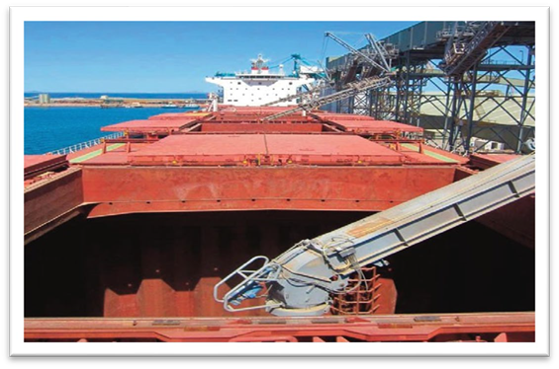
Fuel can be discharged at Berth 1 via a branch connection at the Berth from the 350mm pipeline owned by Southern Ports that connects the Port to the fuel storage facility, some three kilometres away. Ship’s manifold connections are by 200-millimetre flexible hoses.
Southern Ports operates a combined container handling crane and bulk products discharge grab at the Port of Esperance on Berth 2 for container handling and discharge of bulk products.
This crane has the following characteristics:
- Portainer style crane combined with semi-automated discharge grab; and rotainer for loading of bulk products arriving to the port in containers;
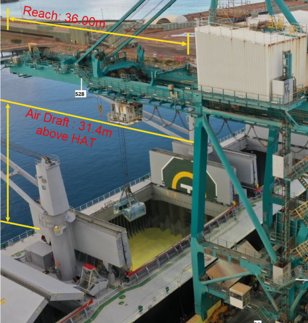
- Maximum reach is 36.0m from fender face (approx. 13 container widths) in container mode; or 26.5m from fender face in grab mode.
- Gantry travel range 170.0 metres;
- Maximum air draft for container crane operations 31.4 metres above HAT; Please note that this is air draft for the working deck only, not the ships maximum air draft.
- Maximum lifting capacities are 28 tonnes with grab bucket, 40 tonnes below container spreader;
- Maximum arrival displacement is 82,000t;
- Wind speed for shut down 20 metres per second or 40 knots.
Fuel can be discharged at Berth 2 via a 350mm pipeline owned by SP-POE that connects the Port to the fuel storage facility, some three kilometres away. Ship’s manifold connections are by 200 millimetre flexible hoses.
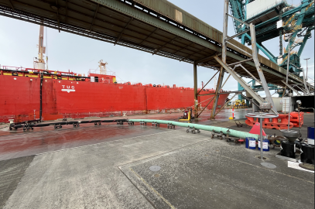
Bulk fertiliser products are also discharged at this berth using ship’s gear and grabs (All sulphur and fertiliser vessels must be geared), discharging through mobile hoppers into road vehicles. A rate of 100 tonnes per hour per grab is normally achieved.
Southern Ports operates a bulk ore loader at the Port of Esperance's Berth 3. It has a maximum loading rate of 4,500 tonnes per hour and an operating loading rate of 2,400 tonnes per hour.
This loader has the following characteristics:
- Gantry loader with a single telescopic chute;
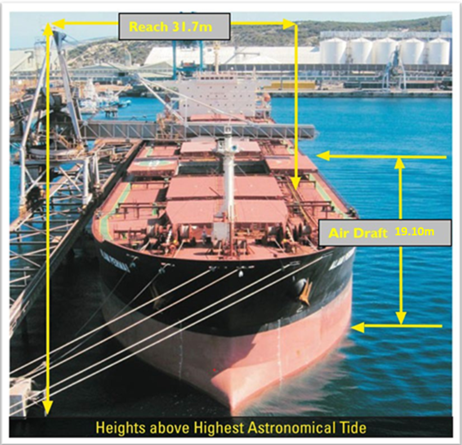
- Maximum reach 31.7 metres from fender face;
- Minimum reach 10.7 metres from fender face;
- Gantry travel range 201.3 metres plus an operating slew angle of 15 degrees;
- Maximum air draft to top of main deck railing is 19.10 metres above HAT;
- Maximum air draft at cranes 34.4 metres above HAT;
- Maximum arrival displacement is 100,000t;
- Wind speed for shutdown 20 metres per second (40 knots) for three seconds or 18 metre per second for 20 seconds; and
- If an excessive wind speed shut down occurs, loading will not resume until the high wind period has passed.
If a vessel has to warp forward or aft in order to load all hatches, the following applies:
- The Harbour Master must be notified of the intention to move the vessel and must approve the operation before the vessel is warped;
- The vessel must not warp more than 10 metres from its original position;
- All lines must be on bollards before the vessel is moved;
- The vessel must always stay within the dredged berth pocket and must always maintain a UKC of not less than 0.6 metres; and
- The Harbour Master may require a Pilot and/or tugs to perform the operation safely. The cost of pilots/mooring crew and/or tugs will be to the account of the vessel.
For the most up to date Inner Harbour Depths see Marine Notice.
Responsibility for the safe conduct of operations while a ship is moored at the dangerous good’s berths (Berth 1 and Berth 2) rests jointly with the Ship’s Master and the responsible terminal representative (Shore Officer). Therefore, before operations start, it is incumbent upon ship and shore personnel that there is full co-operation and understanding on the safety requirements set out in Ship/Shore Safety Check Lists that are based on safe practices widely accepted by the oil and tanker industries.
Chapter VI of the SOLAS 1974 Convention, as amended, and Australian Legislation (namely Marine Orders, Part 33) require that all ships intending to carry grain cargoes in bulk from Australian ports are to demonstrate compliance with the International Grain Code.
Any vessel loading or partially discharging grain at any Australian port may be subject to inspection by AMSA at any time.
The Ship’s Master will be required to complete a Ship/Shore Safety Check List in conjunction with stevedores Person In Charge (PIC) of vessel loading.
Generally, the shore weightometres will be in error by 0 percent to 2 percent of actual weight. However, it is the responsibility of the Ship’s Master to calculate the precise belt error by means of vigilant draft checks.
.tmb-cta.webp?Culture=en&sfvrsn=dfb270b8_1)
Berth specifications
.tmb-image.webp?Culture=en&sfvrsn=42ef0cbb_2)


