Pre-arrival information
Role | Responsibility |
|---|---|
Ship’s Master | Ensure vessel safety and compliance with port requirements; notify Shift Superintendent of emergencies; maintain VHF watch; provide safe pilot boarding; ensure adequate moorings and UKC; prevent pollution; ensure engines readiness at anchor. |
Harbour Master / Delegate | Set/approve movement requirements; determine permitted anchorages; vary towage and scheduling for safety and efficiency; issue local marine notices. |
Duty Pilot | Conduct pilotage; assess environmental limits and LPW mitigation; direct tugs and mooring configuration; advise on safe operations and departures. |
Shift Superintendent (Terminal) | Primary operational contact for incidents/emergencies; coordinate berth readiness and cargo interface with terminal operations. |
Tug Masters / Towage Provider | Provide tug assistance as booked; advise on safe tug line positions; handle tug lines safely; confirm readiness and availability. |
Agent | Submit berth applications; distribute current Local Marine Notices and passage plans to the Master in good time; coordinate services (waste, water, etc.). |
Port Security Officer | Maintain ISPS security arrangements; coordinate access control and seafarer transfers in accordance with port security procedures. |
Legislation, Standards and Codes of Practice referenced by this Guideline are shown in Table 3 below.
| Document reference | Document title |
|---|---|
| IMO / SOLAS / IMPA | Pilot boarding arrangements (IMO requirements and IMPA recommendations). |
| MARPOL | Prevention of pollution from ships – waste, sewage, oils, residues, scrubber discharges. |
| WA Port Authorities Regulations 2001 (Reg 17) | Prohibition of discharge of waste water/substances into port waters without authorisation. |
| AMSA requirements | Compliance with national marine safety and reporting obligations. |
Southern Ports documents referenced in this Guideline are shown below.
| Document reference | Document title |
|---|---|
| Local Marine Notices | Operational notices (Radio Transmissions, Vessel Moorings, Depth Declaration, Permission to use Esperance Anchorages). |
| Berthing Rules | Port berthing rules and scheduling principles. |
| Navigation and Pilotage | Pilotage services, passage plans, waypoints and no‑go areas. |
| Marine Information page | Weather, tides, wind monitor and public environmental data links. |
Ship’s Masters must notify the Port of Esperance’s Shift Superintendent (+61 8 9072 3365 / +61 447 838 290) immediately of any emergency situation on board their vessel.
If a Ship’s Master is in any doubt with regards to the instructions they have been given by the Shift Superintendent they should then contact the Harbour Master’s office (+61 8 9072 3344 / +61 417 922 501).
Refer to charts AUS 119 and AUS 762 for the location of the Port of Esperance Limits.
Unless a vessel is legally compliant with an approved ECDIS for paperless navigation, an original and up-to-date publication of Chart AUS 119 is required to be on board all vessels before they enter Port of Esperance limits. Arrangements can be made to have the chart delivered by tug or pilot launch.
The recommended rendezvous position is 34°00’ S and 121°50’ E.
The Port operates VHF channels 16 and 12. The Port of Esperance’s call sign is “Esperance Port”. The Port VHF radio is not manned 24hrs, and is only available ONE HOUR PRIOR to Pilot on Board time. All vessels are requested to keep clear of VHF channel 13 (working channel for manoeuvring only).
Radio communications can interfere with Port’s cargo operations and should be limited to low power only. Masters are to refer to latest Esperance Local Marine notice on Radio Transmissions.
Ships’ Masters must note the following arrangements in relation to berthing at the Port of Esperance:
Any vessel requiring a berth or anchorage is required to make a berth application by the nominated agent.
Berthing conditions are set as per berthing rules available on the Southern Ports website.
Shipping schedule is as per the port management system available on the Southern Ports website.
The principle of "first come, first served" applies to all vessels wishing to enter Esperance Harbour. This means first vessel to the Pilot boarding ground one nautical mile east of Cull Island will be given priority. This principle can change under certain conditions, such as:
- Tide restricted vessels;
- Where the affected parties agree to the change; and
- Unless otherwise arranged with Management if another vessel’s cargo is not ready.
As per Southern Ports procedures, berthing or departure may be delayed when the Environmental Limits are meeting or exceed the following:
| Vessel Type | Channel Entry – Max Wind Speed (10‑min Avg) | Channel Entry – Max Wind Speed (Gusts) | Max LPW (Actual or Forecast) | Max Arrival Displacement (t) |
|---|---|---|---|---|
| Container Ship | 25 | 30 | 10 cm | 82,000 (B1) / 100,000 (B2) |
| Wood Chip Ship | 25 | 30 | 10 cm | 82,000 (B1) |
| Bulk Ship (LOA < 230 m) | 25 | 30 | 10 cm | 82,000 (B1) |
| Cape or Newcastle Max Ship (LOA > 270 m) | 25 | 30 | 10 cm | 100,000 (B3) |
Vessels may be required to delay departure from berth at the pilot’s discretion if wind speeds are greater than 30kts.
Environmental conditions can be monitored using the public information available through the Southern Ports website as per below:
- Esperance weather - choose Beacon 2
- ATM Ocean
Long Period Wave (LPW) event mitigation is required when the forecast indicates that the port may experience a period of increased surge or swell. The duty pilot is required to identify any vessels that may require additional measures to ensure their safety whilst alongside a berth in the port. The use of additional mooring lines, preventer lines (known as anacondas), chafe protection, availability of extra mooring lines on deck and tug availability are some of the measures the Duty Pilot may implement at their discretion. During periods of high wind and swell increased vigilance is required to ensure the constant monitoring of vessels whilst alongside
- Southern Ports provides a 24-hour pilotage service at the Port of Esperance, but it is not an “on demand” service. Generally, 4 hours' notice (6 hours after office hours) is required to amend a booking subject to the following considerations:
- Shipping movements occurring after 2000 hours must be confirmed by 1630 hours daily.
- See ‘Berthing Rules’.
- Ships that complete their discharge earlier than expected may bring their departure forward, providing that it is brought forward to 2200 hours or earlier.
- Shipping movements booked between 2200 hours and 0600 hours that are delayed must be put back to 0600, or 8 hours after notification whichever is later.
- Variations to shipping are subject to marine services availability; and
- Variations must not conflict with existing shipping movements.
Eight designated anchorage positions (A, B, C, D, E, F, G and H) are situated east of the main breakwater between Low Rock and Limpet Rock (see Aus Chart 119 and Interactive Port Map).
Name | Latitude | Longitude | Radius |
|---|---|---|---|
A | 33˚ 51’.8S | 121˚ 55’.8E | 0.35nm |
B | 33˚ 52’.35S | 121˚ 56’.3E | 0.35nm |
C | 33˚ 53’.1S | 121˚ 56’.3E | 0.35nm |
D | 33˚ 51’.6S | 121˚ 56’.6E | 0.35nm |
E | 33˚ 52’.15S | 121˚ 57’.2E | 0.35nm |
F | 33˚ 53’.5S | 121˚ 57’.2E | 0.35nm |
G | 33˚ 53’.9S | 121˚ 58’.0E | 0.35nm |
H | 33˚ 54’.3S | 121˚ 57’.2E | 0.35nm |
WARNING: Vessels MUST NOT immobilise their engines without permission from the Port Authority. Permission will be granted by the Port Authority via e-mail confirmation. See section Engine Immobilisation.
The Engine Immobilisation form can be found at www.southernports.com.au/esperance/forms
- Increased situational awareness is required when using the Esperance anchorages as the seabed is sand and does not provide good holding ground.
- The vessels may only use the designated anchorage determined by the Harbour Master or Duty Pilot.
- A STCW qualified officer of the watch is to be on the bridge at all times. The watch keeper is required to constantly monitor the ship’s position and the movement and proximity of other vessels within Port Limits.
- A VHF watch on channels 12, 16 and 70 must be maintained at all times.
- All defects, incidents and near misses must be reported to AMSA and the Port Authority as soon as is reasonably possible.
- Engines must be available on not less than 30 minutes notice at all times.
- When winds of 25 Knots or higher are forecast or experienced, engines must be available on immediate notice.
- When winds of 40 Knots or higher are forecast or experienced, the vessel must weigh anchor and depart to a safe location outside port limits.
- The Master must take all measures possible to ensure the vessel remains in its designated anchorage.
- Notwithstanding the above, if the vessel drags its anchor, or for any reason is unable to maintain its position, the vessel must weigh anchor and depart to a safe location outside port limits (vessels agent to notify duty pilot via email).
Please refer to the Southern Ports website Marine Notices “Permission to use Esperance Anchorages”.
For safe navigation, vessels should be trimmed by their stern, their propeller fully immersed and the forward draft not less than 2% of vessel’s LOA. Vessels that cannot meet these criteria may be delayed until compliant at Harbour Master / Duty Pilots discretion.
Standard vessel movements within the Port of Esperance require a minimum of 2 Tugs on each movement. Additionally, the use of 1 Tug may be required for vessel warping movements at the Duty Pilots discretion.
Furthermore, the following vessels will require the use of 3 Tugs in assistance;
(1) Any vessel with a length overall ≥ 270m.
(2) Any vessel with a displacement ≥ 120, 000 tonnes.
Any variation to the above requirement is only at the discretion and approval of the Esperance Harbour Master or their delegate.
Pilot boarding arrangements must comply with IMO requirements and IMPA recommendations. (See: https://www.impahq.org/impa-policies-publications/pilot-ladder-poster and Pilot ladder rigging diagram).
In the case of a combined ladder, the Ship’s Officer in contact with the bridge should be positioned at the lower gangway platform.
The ladder is to rest firmly against the ship’s side and should be lashed to the pilot ladder lugs.
If the vessel does not have securing lugs, securing magnets are available from the port and should be requested prior to the pilot boarding.
The Master is to provide a lee for the safe boarding of the pilot.
For more detailed information, please consult Marine Notices.
All vessels are required to provide the Pilot with a Pilot Card containing appropriate information. The Pilot will provide the Master with a Port Passage Plan.
The Agent is to ensure that the Master receives the local Marine Notices electronically in good time prior to arriving at port limits.
Bridge Resource Management (BRM) principles for pilotage apply.
Should the Master or Officer of the Watch have any concerns about any part of the manoeuvre, they are to bring this to the attention of the Pilot who will respond to their concerns.
Port of Esperance Pilot’s welcome feedback, comments, and suggestions - contact us.
Four tugs operate at Port of Esperance:
Tug name | Bollard pull | Horsepower | Propulsion |
Cape Pasley | 65 tonnes | 5,400hp | Azimuth stern drive |
Shoal Cape | 68 tonnes | 5,590hp | Azimuth stern drive |
Hellfire Bay | 68 tonnes | 5,590hp | Azimuth stern drive |
Lillian Mac | 70 tonnes | 5,632hp | Azimuth stern drive |
On arrival, tugs make fast with tugs’ lines at positions agreed during Master Pilot exchange. The Tug Masters will indicate if different locations might be preferred to secure their vessels. Tug lines should be handled with care. The Pilot will advise the vessel when to let go of the line and, thereafter, the line should be lowered in a slow and controlled manner onto the deck of the tug, taking particular care not to injure personnel on either vessel. The use of any metal weight at the end of any heaving line is strictly prohibited. Tugs shall be made fast through suitable panama leads, roller fairleads are not to be used.
- Ship’s Masters are to adequately secure their vessels at all times when alongside a berth.
- Mooring lines are to be tended at appropriate intervals throughout each 24 hour period to ensure vessels are securely positioned alongside the berth without ranging. All lines are to be in good condition and kept firm with even tension to minimise the risks of lines parting. Winch brakes must be in good condition and applied firmly when lines are not being adjusted;
- Ship's Master must ensure vessel complies with relevant Local Marine Notices as they pertain to the mooring and securing of the vessel.
- Ship’s Masters concerned that they are unable to comply with this requirement must contact the Port of Esperance Harbour Master immediately and suspend loading until concerns are dealt with; and
- The pilot will advise the Master as to any changes to the mooring system.
- For updated information, please consult our Local Marine Notices “Vessel Moorings”.
The use of shore breast lines (Shore Tension™) is required at all times. In addition, depending on the configuration of the vessel and other circumstances, systems such as “preventers” can be deployed:
A preventer is a short additional breast line with one eye attached to a shore bollard and at the ship’s end a soft shackle through which a ship’s mooring breast line is secured and sent back to the vessel.
Shore Tension™ is a shore breast line that is passed from the shore to the vessel through the ship’s center leads fore and aft. This line is secured directly to the vessels’ bollards. The tension on the line is controlled from the shore by way of hydraulic rams.
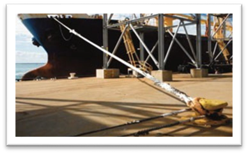
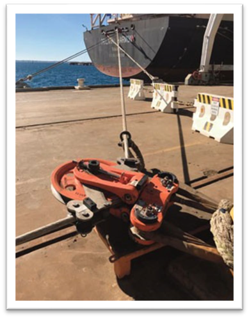
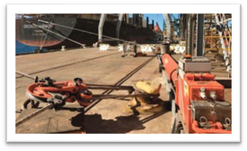
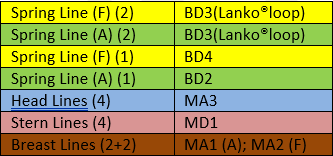
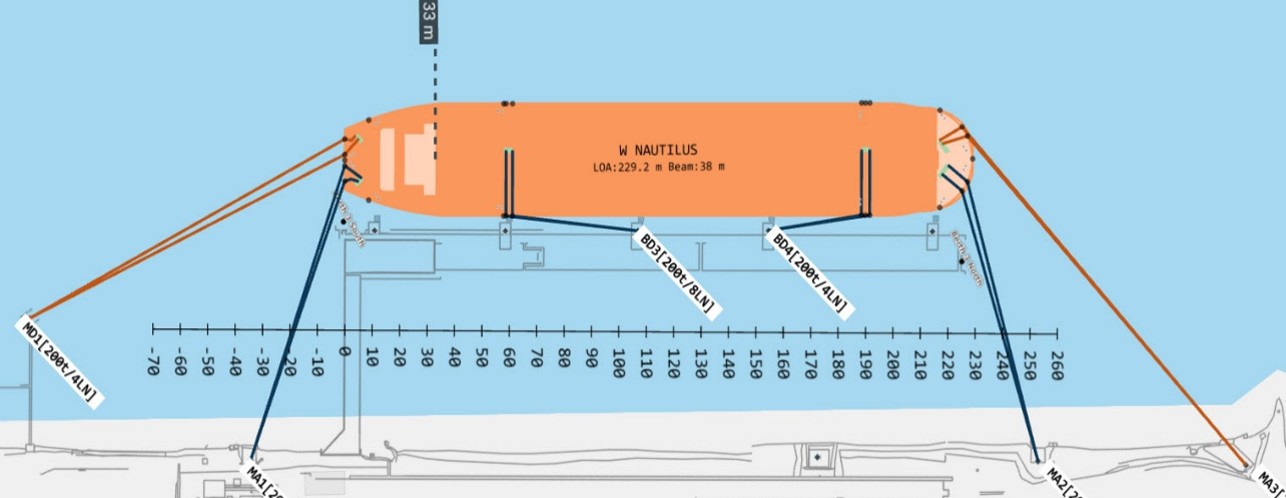
On Berth No.3, for Cape size vessels, four headlines, four stern lines, three forward springs, three after springs, two forward breast-lines and two after breast-lines are required for tie-up. Spring lines are sent by heaving line; breast lines, headlines and stern lines are sent by lines launch.
Port of Esperance, Berth 3 Mooring Schematics Cape Ships
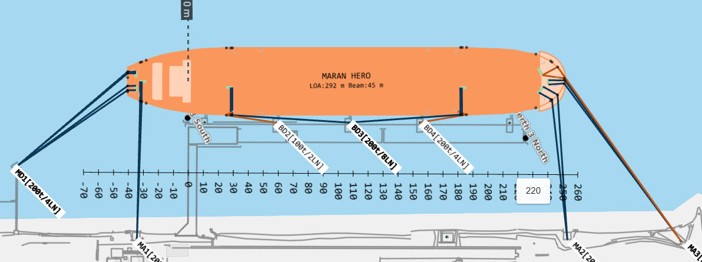
IMPORTANT!
The vessel must be able to comply with mooring arrangements as outline in the Esperance Marine Notice on Mooring Lines for Berth 3. If the vessel does not have sufficient lines (minimum of 18 LINES for cape size vessels)(minimum of 12 LINES for non-cape size vessels) mounted on drums as shown in the diagrams above and below, mooring lines must be flaked on deck, ready for use prior to the pilot boarding the vessel.
If the vessel is unable to moor as specified, the vessel will be put to sea and not permitted back into the port until it is able to comply.
NOTE: Quad hooks have been installed on BD3. These hooks have load cells and are monitored within the port. When the Pilot arrives on-board they will confirm with the Master on the method of tie up and the number of lines required.
Port of Esperance, Berth 3 Mooring Schematics Non Cape Ships
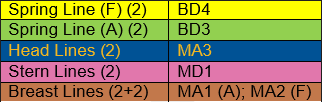
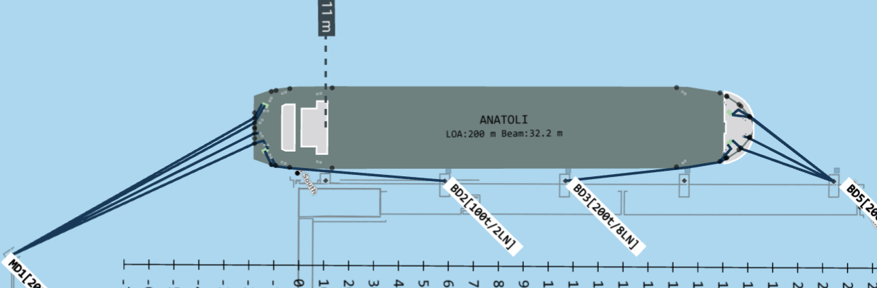
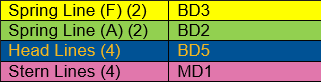
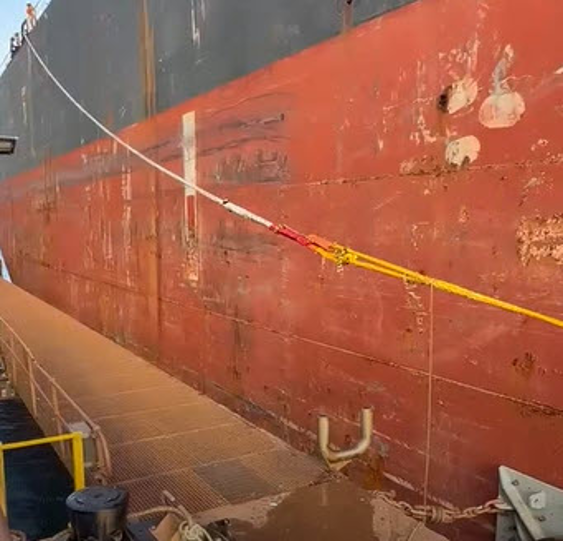
Berth 3 Cape size vessels use the Lanko®loop system for the spring lines – The following information is to notify ship’s crew of shore side procedures only.
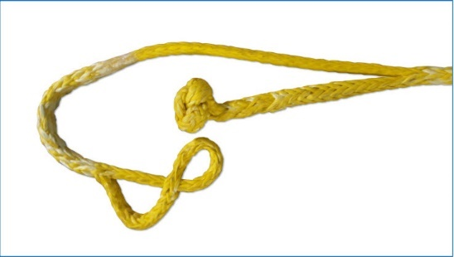
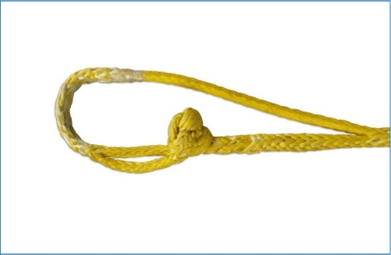
Lanko® loop lines knot and eye configuration
The Lanko® loop is a custom-made synthetic fiber rope eye that can be repeatedly opened and closed as needed. It uses a simple knot and eye connection.
Equipment
- 4 x 40mm Lanko® loop lines (50m) secured to the mooring hooks on BD3 with two leading forward and two leading aft.
- Messenger lines will be used to assist in heaving lines ashore for securing to the associated hook and to ensure the line does not fall between the ship and the fenders.
- The third spring line (additional spring line) used forward and aft will not use the Lanko®loop system. The additional spring line forward will be placed on hook BD4 and the additional spring line aft will be placed on hook BD2.
- Ship’s crew will send ashore spring lines as they normally would. Additional time is required for shore crew to attach the Lanko Loop.
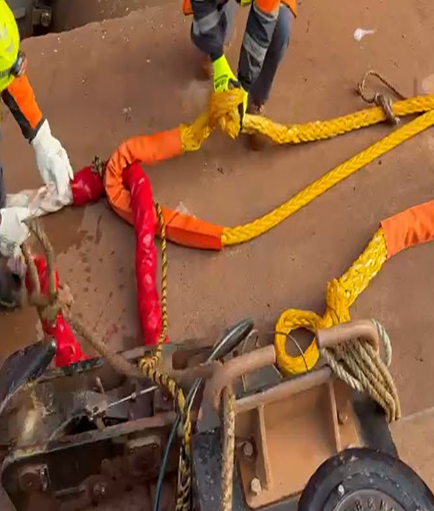
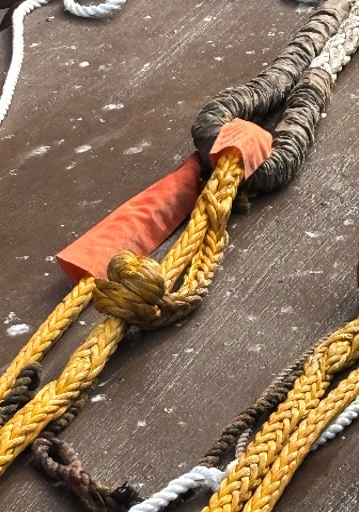
Lanko® loop line connections
Masters are to ensure that they maintain an under-keel clearance of 0.60 metres at all times alongside berths and 1.3 metres in the swing basin and channel.
For updated information, please consult our Local Marine Notices “Depth Declaration” on our web page.
All MARPOL Regulations, as well as our Local Marine Notices are to be strictly complied with.
Port of Esperance applies Regulation 17 of the Western Australian Port Authorities Regulations 2001 (Dec 2022) that states: “Unless authorised by a member of staff of the Port Authority, the Master of a vessel must not cause or permit any waste water or waste substances of any kind to be discharged from the vessel onto any part of a wharf or into the waters of a Port.”
Port of Esperance applies this regulation to the following forms of waste water:
- Dry bulk cargo residues, hold cleaning and deck washings;
- Sewage;
- Oil, bilge water and oily water;
- Sediment;
- Grey water;
- Other waste water And
- Open Loop Scrubbers
Ship’s Master must confirm that EGCS is compliant with AMSA/IMO regulations and has been tested and found to be functioning in accordance with those regulations. Additional measures required: vessel to demonstrate (current laboratory testing certificates - within three months) that the water quality of the emissions of their on-board system are able to comply with the relevant state water quality requirements. If a vessel is unable to comply, and must discharge waste water, the Ship’s Master must contract a Controlled Waste Carrier in Esperance that can collect and dispose of this waste. Contact must be made in advance to enable the correct fittings to be installed to allow collection of this waste. All Ship’s Masters must declare compliance with these conditions.
For updated information, please consult our Local Marine Notice “Marine Pollution & Ballast Water Management”.
Ships’ Masters are to observe the following in relation to a vessel’s cleanliness when in Port of Esperance waters:
- Masters are to ensure that cargo residues do not enter Port of Esperance waters from their vessels by any means.
- Under no circumstances should cargo residues enter Port waters during periods of heavy rain, high wind or de-ballasting of cargo holds.
- Ballast and other discharges must not be allowed to fall on Port wharfs, plant or equipment. Non-compliance with this directive may result in a Ship’s Master being prosecuted under Australian Marine Orders and Environmental Legislation.
- For updated information, please consult our Local Marine Notice “Marine Pollution & Ballast Water Management” on our web page.
Discharge of garbage from vessels and cleaning of sea containers is regulated by the Biosecurity Act 2015. To comply with the Biosecurity Act and regulations, shipping agents
or the ship’s master must notify the Shipping Officer during the berth application process of their requirements for disposal of biosecurity garbage waste from the vessel (or from imported sea containers). All biosecurity waste must be double bagged and tied up and deposited in specially marked “BIOSECURITY” bins on the berth or bins near the container inspection stand.
Vessels MUST NOT immobilise their engines without permission from the Port Authority. Permission will be granted by the Port Authority via email confirmation.
This Engine Immobilisation form needs to be completed.


